
Charlottesville Deed Record Types
The Charlottesville Circuit Court Clerk records several kinds of land instruments. A deed records a conveyance. A deed of trust creates a recorded security interest. A release shows that an earlier instrument was discharged. Plats and judgment liens round out the land-record and historical court-record landscape, each searchable through the clerk's recording system.
| Deed Type | What It Does | Common Use |
|---|---|---|
| Deed | Records a transfer of a land interest according to its stated terms. | Trace a grantor and grantee or confirm a conveyance. |
| Deed of trust | Places a recorded security instrument against property. | Check a financing record and any later release. |
| Release deed | Records release or satisfaction of an earlier interest. | Follow an older deed of trust or lien. |
| Plat | Shows a recorded lot or subdivision layout. | Match a parcel's legal description to a lot. |
| Judgment lien | Indexes a court-related claim in land records. | Check possible encumbrances and historical dockets. |
A deed and a lien answer different questions. The deed states a conveyance. A security instrument or judgment lien records a claim that may affect the parcel. Search for the related release or satisfaction rather than assuming a debt is still open, and treat the clerk's index as a starting point rather than a complete legal conclusion.
The Charlottesville Grantor-Grantee Index
Virginia's Secure Remote Access system is the statewide doorway to local circuit-court land records. Charlottesville's route through SRA works as a name-based index. Grantor and grantee names drive the search. No fixed set of buttons or filters governs every session. Start with a party name. Then verify each hit against the legal description and parcel.
- Search the current owner as grantee, the party who received the interest, and locate the likely purchase deed.
- Read the grantor, the party conveying the interest, plus the legal description and any book/page or instrument reference shown.
- Search the grantor as a prior grantee to find the deed by which that party acquired the property.
- Repeat backward; when the online result ends, use the Library of Virginia catalog and the clerk's historical records.
Trace one transfer at a time. Start with the present grantee. Search that party as a grantor to find the later conveyance. Then follow its prior grantee backward. Preserve the instrument reference at each step. Keep the parties, the recording date, and the legal description too. Middle initials and prior surnames can change an index entry. So can business punctuation, trustee wording, and subdivision names. An older entry may not use today's street address.
Multiple entries call for comparison. Check the legal description against the Assessor's parcel. The recorded plat works too. Do this before choosing a deed. A deed's street address can be absent or outdated. Lot and block wording stays useful across changing street labels. Need evidence in a current transaction? Request the image or official copy from the clerk. Keep its recording date and reference in your notes.
- Grantor
- The person or entity named as transferring an interest.
- Grantee
- The person or entity named as receiving an interest.
- Chain of title
- The linked sequence of conveyances for one parcel.
- Book and page
- A volume reference; exact current SRA result fields are not confirmed.
Request a Charlottesville Deed Copy
When an image is not available through SRA, contact the Charlottesville Circuit Court Clerk at 315 East High Street or call 434-970-3766. The clerk's office is open from 8:30 a.m. to 4:30 p.m. Certified-copy charges are set locally. Call ahead before ordering or mailing a request. The assessor may also hold deed and plat references. Those can help pinpoint the right instrument.
Recorded, not guaranteed. A Charlottesville deed index shows indexed instruments, not every possible interest or defect. A title professional reviews the chain and the legal effect of each record.
Charlottesville Clerk Image Access
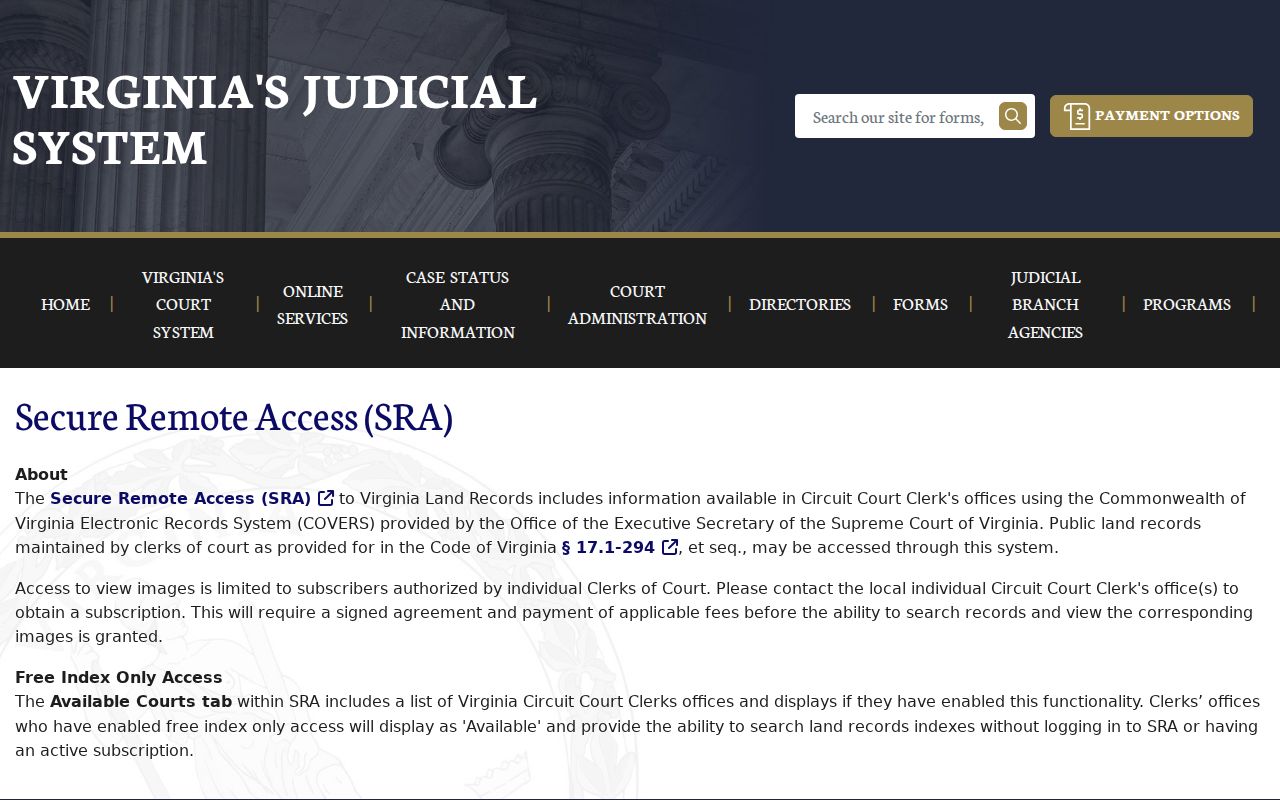
The SRA landing page explains that each circuit clerk controls the level of remote image access. The clerk sets the terms. A free index may appear where enabled, but an image can require a subscription agreement authorized by the local clerk. Charlottesville's copy fee is not published statewide. Check the available-courts indicator. Call before assuming a free result.
The statewide Virginia SRA land-record page outlines this split between index and image for users searching Charlottesville deed records. The Virginia courts SRA page describes remote land-record access and image terms.
The clerk's office handles image requests, certified copies, and help with a local deed search. Use it when an index hit needs more.
Older Charlottesville Index Runs
The Library of Virginia catalog is unusually useful for a chain that reaches past the online system. Its general deed indexes cover volumes 1 through 229, spanning 1888 to 1961 in letter ranges. The catalog lists books from 1888 to 1902 on reels 14 through 19. Early indexes sit on reel 14. No exact cutover year for SRA is established. Do not treat 1961 as an online limit.
Find the book reference in the index letter segment. Then open the matching deed-book reel. A spelling variant or an older subdivision name may be needed when an entry skips the current street address.
Charlottesville Deed Book Coverage
The local-history catalog offers a series map rather than one full-text search. Use it to pick the right reel or clerk record.
Treat the dates as coverage clues. They do not prove that every instrument from a year sits in one volume. The catalog separates letter ranges and record series. A reference in one index can lead to a differently labeled deed book. Common names create pileups. Compare the date, the lot description, and nearby entries before choosing a reel.
| Series | Verified span | Where to continue |
|---|---|---|
| Corporation Court deed books | 1888-1902; reels 14-19 | Match the deed index letter to a book reel. |
| General deed indexes | 1888-1961; volumes 1-229 | Use the index range and letter segment listed in the catalog. |
| Release deeds | 1892-1920; reel 23 | Check after finding a deed of trust or lien. |
| Judgment lien indexes | 1888-1966 in several series | Check plaintiff and defendant indexes by era. |
Charlottesville Releases and Liens
A paid deed of trust can linger in the records. Once the debt is settled, the instrument stays in the chain. It remains there until a release or satisfaction is recorded against it. Search releases by party name and older reference. The Library of Virginia holds a Charlottesville Release Deed Book covering 1892 to 1920. It also holds a miscellaneous lien book from 1955 to 1960, and judgment-lien index series spanning several eras.
Mechanic's liens point to court cases too. Search by owner, claimant, and parcel description. Then ask the clerk for the underlying document itself. A lien record does not prove a live debt. Find the release or court disposition before assuming the encumbrance still binds the property.
Deeds of trust and releases sit in land records. Judgments and other liens may sit in separate indexes. Keep the original instrument reference when looking for a satisfaction. A release can be filed under a lender, trustee, debtor, or successor name. Name spellings vary. The index may spell a party differently. Broaden the search before concluding that no release appears.
Charlottesville Estate Conveyances
Deed chains sometimes jump. An owner's name suddenly gives way to an estate or trust, and the deed alone cannot explain why. Wills and fiduciary books can. The Charlottesville clerk handles wills, estate records, and recorded land instruments in one office. The Library of Virginia lists a General Index to Wills from 1888 to 1986, Will Books from 1888 to 1915, and fiduciary books in multiple later runs. These are microfilm collections. They do not mean every estate record is online.
Try the owner, executor, administrator, or trustee as a grantor or grantee in the deed index. A commissioner or executor deed ties a court or estate event to the next recorded transfer. The index may not explain the link. In that case, ask the clerk about probate procedure and copy rules.
Charlottesville Plats and Reels
A signed Charlottesville subdivision plat must reach Circuit Court within six months of approval. That deadline matters. When a new lot or boundary conflicts with an older deed description, the recorded plat controls the picture. No single archive holds every historic subdivision reel. Use the state catalog and clerk reference instead. Missing-book notes deserve attention too. Commissioners' Bond Book 3, covering 1923 to 1956, and Corporation Court Fiduciary Book 1 are both listed as missing. A gap is not an answer. Search related order books, deed references, court files, and later instruments before treating a missing volume as proof that no event occurred.
Charlottesville dates to 1762. A long ownership question may cross early municipal records and later Corporation Court series. The catalog's 1888 starting ranges describe surviving indexed collections. They are not the city's complete history. Request both plat and deed for a subdivision conveyance, since the plat shows lot layout while the deed explains which interest or parcel changed hands.
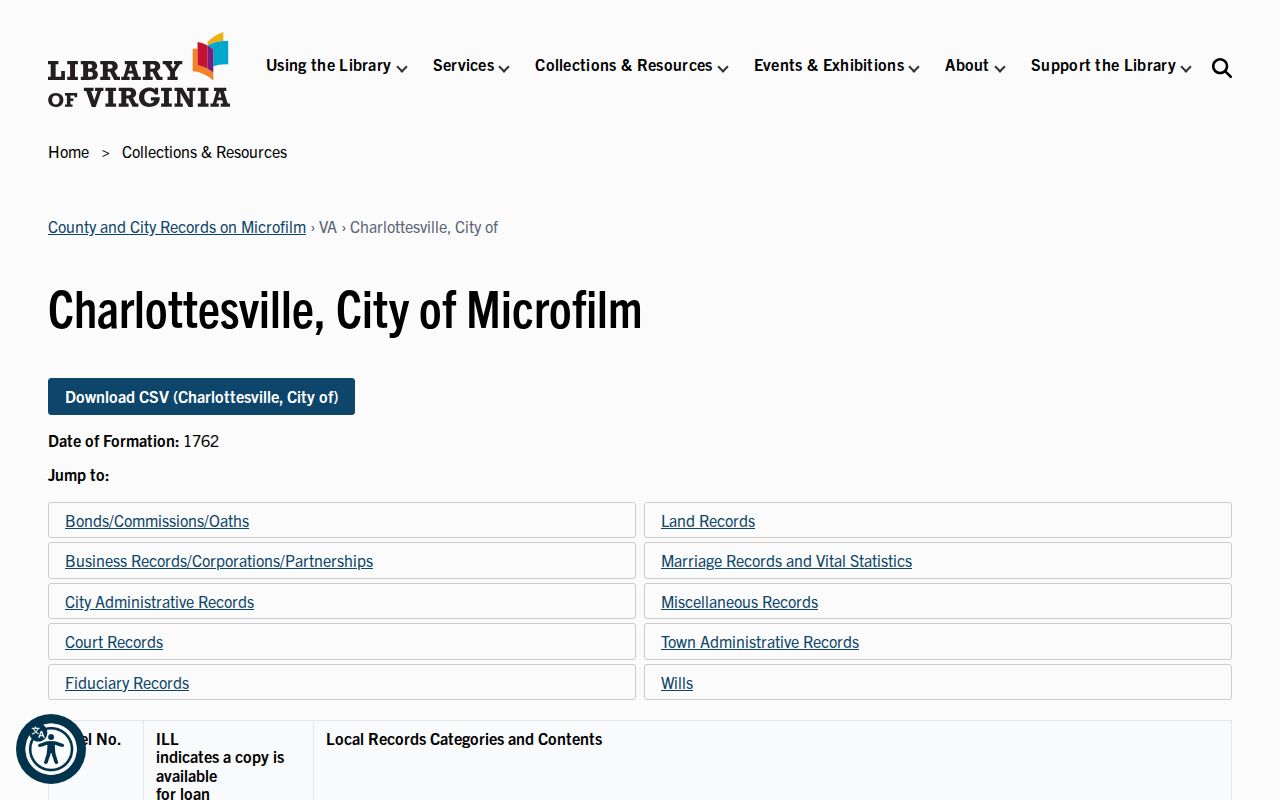
The Library of Virginia lists the Charlottesville local-records reels for older deed and court series.
Check Charlottesville catalog reel notes and letter ranges first.