
Charlottesville Past Owner Sources
Each recorded deed moves you back one owner. It runs from the present grantee to the prior grantor. Charlottesville's SRA page is the usual first stop. It names no first year for the online index. That makes it a practical entry point, not a fixed coverage promise. The Library of Virginia catalog holds the verified historic series. Annual land books help date what the assessment roll said in later years.
| Source | Years It Covers | Where Held | What It Shows |
|---|---|---|---|
| Virginia SRA deed index | Current local coverage not stated | Virginia SRA and Circuit Court Clerk | Recorded parties and land instruments, where indexed. |
| Corporation Court deed books | 1888-1902 | Library of Virginia microfilm, reels 14-19 | Historic conveyances and deed references. |
| General deed indexes | 1888-1961, volumes 1-229 | Library of Virginia catalog and reels | Names that connect an index entry to a book. |
| Annual land books | Online PDFs 2015-2026 | City page; official books at clerk | Owner and parcel details for a particular tax year. |
For the most recent transfer, begin with SRA or the local clerk. When a chain reaches earlier than the online index, use the catalog's letter ranges and book reels. Treat land books as yearly snapshots. They cannot replace deeds or a full title search.
Walk Back Through Charlottesville Deeds
One transfer hands you the next clue. Read the current deed from the grantee side, then search its grantor as an earlier grantee. Match the legal description every time. An old address or parcel number may not survive a split or an annexation-era description intact.
- Find the latest deed for the current owner named as grantee.
- Read the grantor, parcel description, recording reference, and any earlier deed reference on that instrument.
- Search that grantor as a previous grantee, then repeat until the online result ends or a title question is answered.
- Use the Library of Virginia index range and deed-book reel for earlier material; no fixed Charlottesville SRA cutoff is published.
- Grantor
- The party conveying the interest in a deed.
- Grantee
- The party receiving the interest in that deed.
- Chain of title
- The linked sequence of ownership transfers for a parcel.
- Legal description
- The lot or land terms used to identify the property in a recorded instrument.
Charlottesville Chain Depth
Charlottesville's verified deed books begin in 1888. General indexes run through 1961, covering volumes 1 through 229. That archival span does not make every earlier owner or online record complete. Before drawing a hard endpoint, check the Library of Virginia catalog for the exact series, letter span, and reel.
Lawful use. Former-owner research in Charlottesville is for house history, title work, and property diligence. Do not use it to track, stalk, harass, threaten, or harm a living person.
Charlottesville Index and Book Runs
The old index runs in ranges. The Library of Virginia catalog lists general deed-index segments for volumes 1 through 84. These cover 1888 to 1934. Later ranges reach volume 229 and 1961. The earliest deed books, from 1888 to 1902, sit on reels 14 through 19. Reel 14 includes an early index. Later reels continue the deed books.
A former owner's name can miss in an online result. Pin down the era and index letter before requesting a reel. A catalog search by current address can fail. The book may use subdivision, estate, or earlier street wording instead.
For each candidate deed, compare its date. Then compare its legal description with the conveyances on either side. A former owner is the prior grantor in a transfer. But a deed can convey only a partial interest. It may also describe the tract differently from the current parcel. A surname match alone never connects an old record to today's lot.
Charlottesville Releases and Liens
A title chain holds more than deeds. A deed of trust, a release, or a judgment lien can sit between ordinary conveyances. Charlottesville's historical catalog lists a Release Deed Book from 1892 to 1920, a miscellaneous lien book from 1955 to 1960, and judgment-lien indexes running from 1888 through 1966 across several runs.
Search for the related release once you find an older security instrument. A listed lien is not proof it remains open. Look for a release, satisfaction, or later court event. Then confirm it with the clerk.
Charlottesville Probate Transfers
Not every owner change begins with a simple deed. An owner can die, and the land passes through an estate instead. Will books and fiduciary records explain the executor, administrator, trustee, or commissioner named in a later transfer. The Library catalog lists a General Index to Wills from 1888 to 1986, Will Books from 1888 to 1915, and fiduciary material in separate date runs.
Search the fiduciary name in the deed index. Then ask the Circuit Court Clerk how to reach the related probate record. The clerk sets the search fields and copy fees. Restricted or sealed material may need the clerk's procedure or a court order.
The will index runs from 1888 through 1986. Will books cover 1888 through 1915. These are pointers into a collection, not a promise that every later probate file is online. Note the deceased owner, the fiduciary's name, and any deed reference, then ask which surviving book or case record links the estate to the parcel.
Local wills and recorded land instruments share one custodian. The Charlottesville Circuit Court Clerk is that custodian.
Charlottesville Missing Book Notices
Some volumes are simply gone. The Library catalog flags Commissioners' Bond Book 3, covering 1923 to 1956, and Corporation Court Fiduciary Book 1 as missing. A missing book is a useful negative finding. It does not prove the event never happened. When the direct volume is absent, search related order books, fiduciary files, deed references, court causes, and later reconstructed instruments.
The microfilm catalog also holds council records. Those can explain annexations, road changes, or neighborhood growth, and a civic record may clarify why an older description differs from the parcel map used now.
Charlottesville Neighborhood History
Southeast Charlottesville hides several past identities. Belmont and Carlton started as separate 1890s subdivision tracts. They later merged into one larger neighborhood. Fry's Spring carries an even longer chain. The Azalea Hall estate was split up in the early 1900s. Monte Vista joined the city through the 1938 annexation, and land between Cherry Avenue and the city limits came in with the 1963 annexation. That history is layered. A past owner may be indexed under an estate or subdivision name rather than the current neighborhood label.
Start with the current parcel ID to orient the property search. Then compare older deed descriptions and plats against it. The current owner record anchors the present end of the chain. The recorded grantor in each deed points back to the prior owner. A lot described in a 1930s plat may carry a very different address today.
These place names help you find an older index entry. Only the deed and recorded plat establish the true lot relationship. An address may be assigned after an annexation or subdivision. In that case, search both the older description and the newer city parcel reference. Charlottesville deed records reward that double check.
Charlottesville Microfilm Access
The Library of Virginia's local-records catalog lists Charlottesville deed books, general indexes, releases, and liens. Wills, fiduciary books, and marriage registers appear there too. Many reels are available through interlibrary loan. Before requesting one, match the catalog's reel number and letter range to the surname or time period you need. A certified copy of a deed record calls for more. Ask the clerk for an official version rather than a loan copy. The Library's Charlottesville catalog describes the full reel inventory and index coverage.
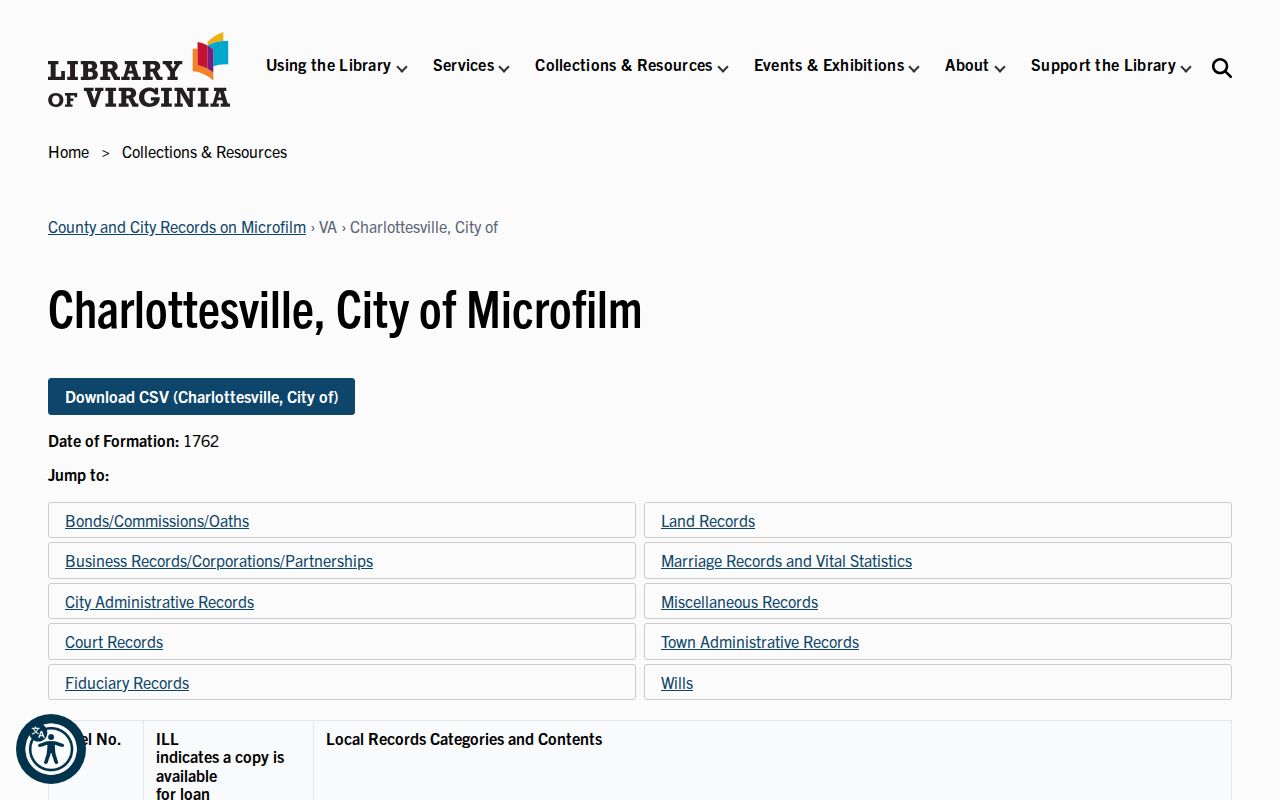
Use the Library of Virginia catalog to plan an older-record request.
Charlottesville Online Index Limits
Virginia's Secure Remote Access page offers a remote entry point for land records. Its public description never states Charlottesville's online cutoff, though. Image access can also stay under the local clerk's control even when the index itself is free, so a property search may hit a wall between the index and the deed images. Search the known grantee first. If the chain stops at an image barrier or an uncertain result, call the Circuit Court Clerk. The statewide Virginia SRA page explains the split between index access and local image subscriptions, and the remote-access page lays out the public land-record route and its access notes.
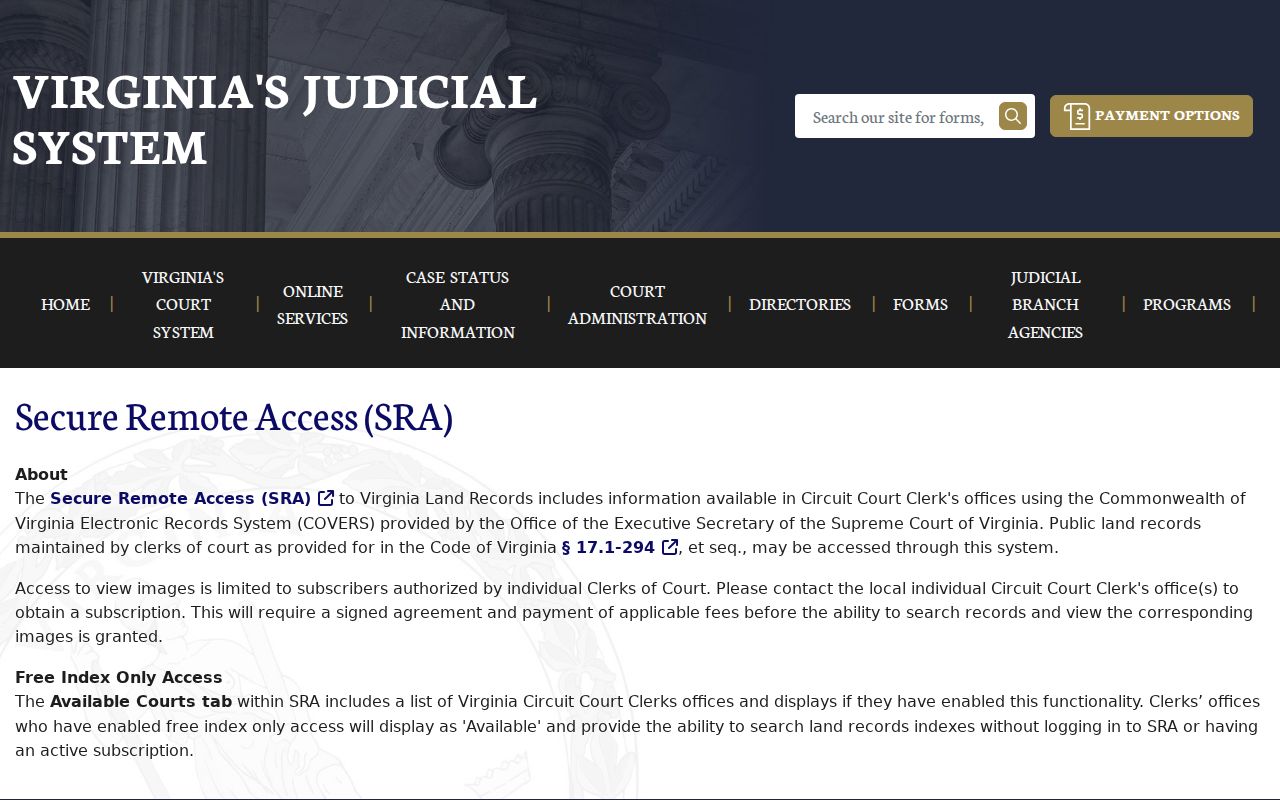
Note: If the portal cannot display the deed you need, the clerk's office and the historic microfilm reels remain the documented next steps.